
Just One More Step: Ratifying International and Regional Protocols
Protocol
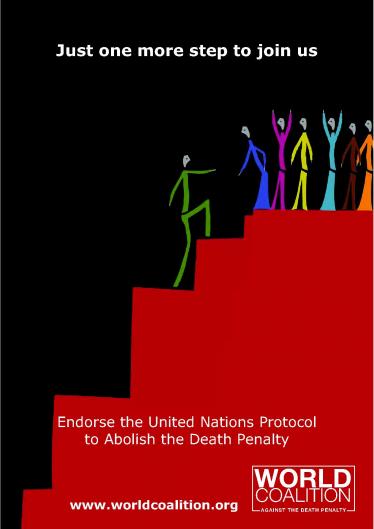
As of 10 June 2024, 91 of the 173 States parties to the ICCPR have ratified or acceded to its Second Optional Protocol aiming at the abolition of the death penalty, most recently Côte d’Ivoire (3 May 2024), Kazakhstan (24 March 2022), Armenia (18 March 2021), Angola (2 October 2019) and the State of Palestine (18 March 2019).
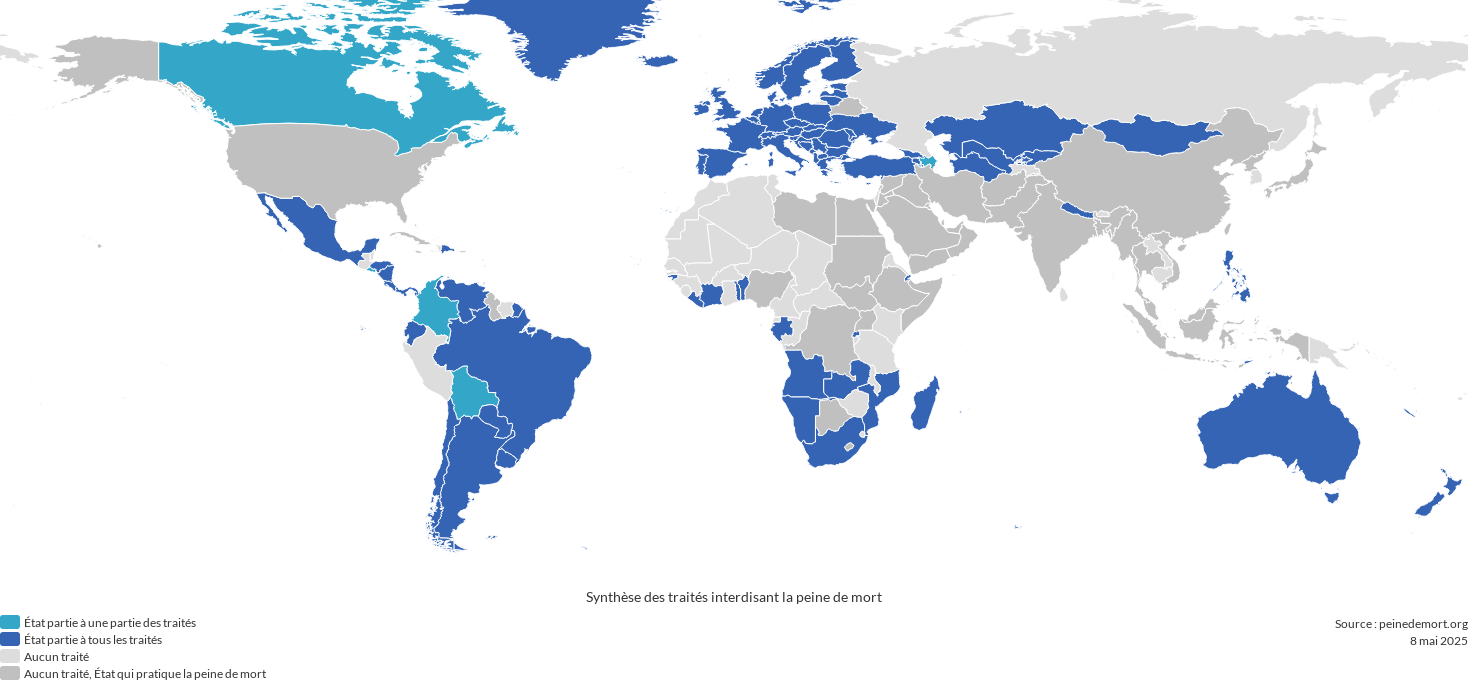
map caption:
State party to part of the treaties
State party to all treaties
No treaty
No treaty, retentionists
Map of ratifications of International and regional treaties aimed at the abolition of the death penalty updated daily by peinedemort.org
Increasing the Number of Ratifications
For the coming year, the World Coalition identified 10 target countries: Central African Republic, Chad, Congo, Fiji, Ghana, Marshall Islands, Samoa, Sierra Leone, Suriname and Zambia.
Supporting Regional Protocol
In addition to the focus on target countries, the World Coalition will also target a specific protocol each year, according to the following calendar:
2023: African Protocol
Adoption by the African Union of a Protocol to the African Charter on Human and Peoples’ Rights on the abolition of the death penalty.
2024: UN Protocol
35th anniversary of the adoption of the Second Optional Protocol to the ICCPR, aiming at the abolition of the death penalty.
2025: American Protocol
35th anniversary of the adoption of the Protocol to the American Convention on Human Rights to Abolish the Death Penalty.
2026: UN Protocol
35th anniversary of the entry into force of the Second Optional Protocol to the ICCPR, aiming at the abolition of the death penalty.
2027: European Protocol
25th anniversary of the adoption of Protocol No. 13 to the European Convention on Human Rights concerning the abolition of the death penalty in all circumstances.
In 2023, which marked the 20th anniversary of the entry into force of Protocol No. 13, Azerbaijan signed the Protocol (8 March 2023) and Armenia ratified the Protocol (19 October 2023). All 46 Council of Europe member states have now signed both optional Protocols to the ECHR relative to the death penalty.
Securing Abolition in Law After the Ratification
The World Coalition monitors respect for the provisions of the international and regional protocols, particularly in the case of States which ratified a protocol but have not abolished the death penalty in law. As of 10 June 2024, three countries are concerned: Liberia, the Gambia and the State of Palestine.
Mongolia acceded to the Second Optional Protocol on 13 March 2012 and abolished the death penalty in law on 3 December 2015. Benin aceded to the Protocol on 5 July 2012 and abolished in January 2016.
Preventing the Reintroduction of the Death Penalty
Finally, the campaign also focuses on the countries that threaten to adopt legislation that would allow for the return of the death penalty, after having ratified the Second Optional Protocol to the ICCPR, namely Turkey and the Philippines.
Take action
-
Spread the information!
To increase the visibility around this campaign, we invite you to disseminate the Information Leaflet introducing the Protocols on your organisation’s website, on social media or in your Newsletter.
- Write to policy-makers! Regardless of your organisation being in a target country or not, you can write official letters to advocate for the ratification by using the Lobbying Kit.
- Organize advocacy actions at capital levels!The meetings with government officials are often the most efficient means to convince policy-makers to ratify the Protocol, you may use information from the Ratification Kits.
- Mobilize local partners! Involve relevant national civil society, encourage the development of a national ratification strategy and participate to lobbying missions in the country using a Ratification Kit for Parliamentarians and other documents.
- Work with international organizations: the UN, the Council of Europe, the African Commission on Human and Peoples' Rights or the Inter-American Commission on Human Rights.
Share the campaign
Share the campaign